Colby Jack is the marbled American cheese that brings together golden Colby and pale Monterey Jack in the same block. Colby was developed in Wisconsin in the late 1800s, while Monterey Jack became known for its mild flavor and smooth texture. Put the two together and you get the cheese many people know simply as Co-Jack or Marble Jack. Its orange-and-white pattern may be the first thing you notice, but the more interesting part is what gives the cheese that soft, moist texture instead of the firmer bite associated with cheddar.
Getting Colby Jack right at home can be tricky when the cheese turns out too dry, too firm, or poorly marbled. This guide explains how to avoid those problems.
From Milk to Mature Cheese
Making Colby Jack at home takes more waiting than active work. The times below are useful estimates, but your milk, temperature, equipment, and handling can change them, so don’t feel you need to force every stage to finish exactly on schedule.
| Stage | Approx. time |
| Preparation | 15 minutes |
| Milk ripening | 45–60 minutes |
| Curd setting | 45–60 minutes |
| Cutting and heating | 45–60 minutes |
| Washing and draining | 20–30 minutes |
| Pressing | 12–24 hours |
| Drying | 2–3 days |
| Aging | 4–8 weeks |
The Simple Ingredient List
For a small homemade batch, you’ll need:
- 2 gallons whole pasteurized milk
- Mesophilic cheese culture, according to package directions
- Liquid rennet, according to package directions
- Calcium chloride, if needed for your milk
- 1 teaspoon annatto for the orange Colby portion
- Cheese salt, about 2% of the finished curd weight
- Cool, non-chlorinated water
- Cheesecloth or butter muslin
You’ll also need a large stainless-steel pot, thermometer, long knife or curd cutter, colander, cheese mold, and press.
When a specialty ingredient isn’t easy to find
| Ingredient | Replacement | What to expect |
| Mesophilic culture | Another suitable mesophilic cheese culture | The flavor may vary |
| Liquid rennet | Microbial or vegetable rennet | Setting time can differ |
| Annatto | Leave it out | The cheese will stay pale |
| Cheese salt | Plain non-iodized salt | Use one without unnecessary additives |
| Calcium chloride | Leave it out when the milk forms a good curd | The curd may be softer |
Annatto is the easiest one to skip. It gives the Colby its familiar color but isn’t responsible for the cheese’s basic texture or flavor.
Directions
The important thing here is not speed. Colby Jack depends on controlling moisture and acidity, so give each stage enough time to do its job rather than pushing the curds along.
1. Warm the milk
Pour the milk into a sanitized pot and slowly bring it to about 88–90°F (31–32°C).
Add the mesophilic culture and stir gently until distributed. Cover the pot and leave it alone for around 45–60 minutes.
2. Set the curd
If your milk needs calcium chloride, add it according to the product instructions.
Dilute the rennet in cool, non-chlorinated water and stir it into the milk gently. Stop stirring once it is mixed.
Cover the pot and leave it undisturbed until the milk forms a firm curd with a clean break. This often takes 45–60 minutes, but the curd matters more than the clock.
3. Cut the curds
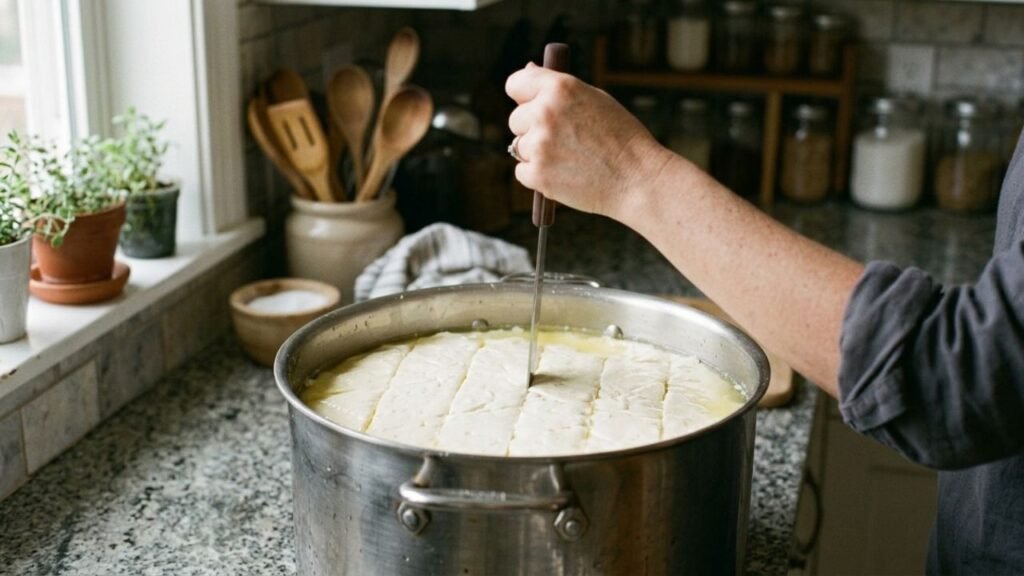
Cut the curd into pieces of roughly ½ inch.
Try to keep the pieces reasonably even. Very small curds release more moisture, while large uneven pieces can cook differently.
Let the cut curds rest for about five minutes.
4. Heat the curds gently
Slowly raise the temperature to around 102°F (39°C) while stirring carefully.
Continue gentle stirring for approximately 15 minutes, allowing the curds to firm without crushing them.
They should feel noticeably firmer while still retaining plenty of moisture.
5. Don’t skip the Colby wash
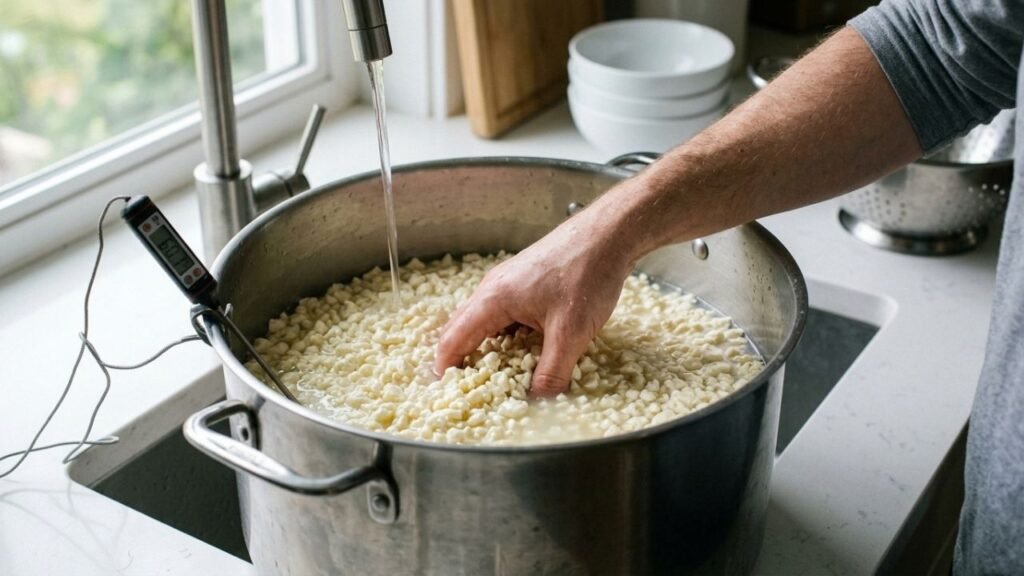
Drain the whey until it is close to the level of the curds.
Add cool water gradually, bringing the curds down to roughly 80–86°F (27–30°C). Stir gently for around 15 minutes, then drain.
This washing stage is one of the details that gives Colby its character. Cooling the curds and reducing the lactose available for further acid development helps produce a softer, milder cheese rather than pushing it toward the firmer texture of cheddar.
6. Salt the curds
Weigh the drained curds and use about 2% of their weight in cheese salt.
Sprinkle the salt evenly over the curds and mix gently. Don’t knead them or compress them into a solid mass yet.
7. Create the Colby Jack marble
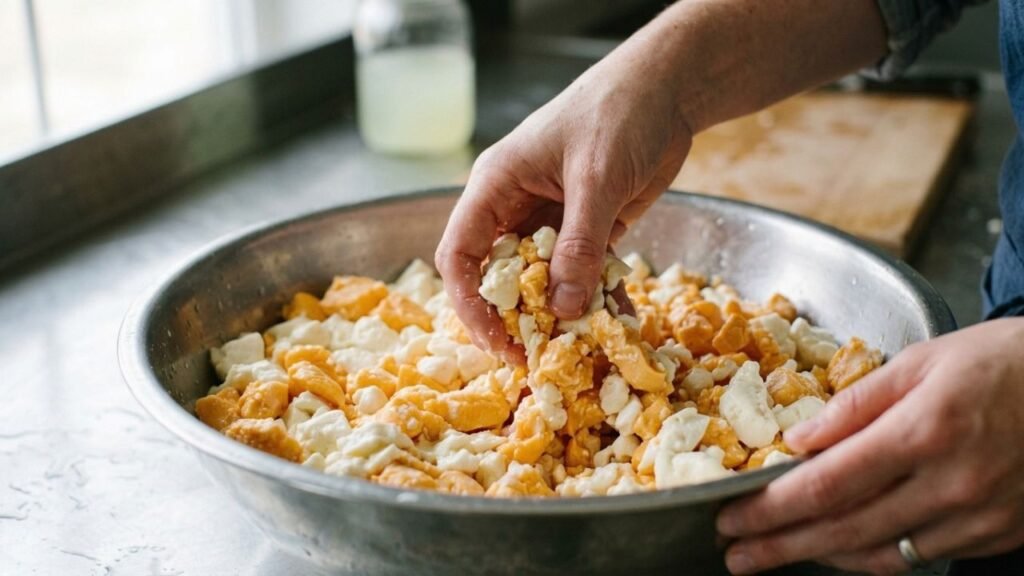
For the orange portion, annatto should already have been added to the Colby side of the cheese. The Monterey Jack curds remain pale.
Combine the two curds with a few gentle turns.
Don’t overmix. The goal is to keep recognizable pieces of orange and white throughout the cheese rather than blending everything into one color.
8. Fill and press
Line the cheese mold with clean cheesecloth or butter muslin.
Add the curds and gently settle them into the mold. Fold the cloth over the top, place the follower on the cheese, and begin pressing according to your mold’s recommended schedule.
Flip and redress the cheese as required.
The aim is to knit the curds together evenly, not to squeeze every bit of moisture out of them.
9. Dry and age
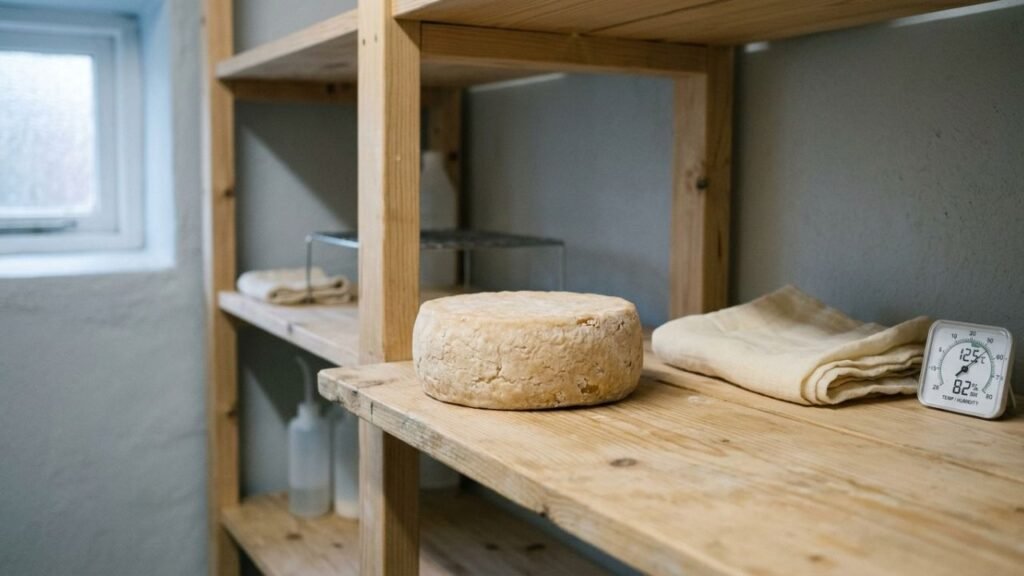
After pressing, remove the cheese from the mold and let its surface dry in a clean environment for around 2–3 days, turning it regularly.
Move it to a suitable aging environment once the surface is dry. Around 50–55°F (10–13°C) is commonly used.
Allow approximately 4–8 weeks for a young, mild cheese.
Let the Texture Do the Work
Colby Jack is especially useful in dishes where its mild flavor and melting texture can come through. Slice it for sandwiches, melt it into grilled cheese, add it to burgers or use it in quesadillas.
It also works well on a simple snack board with crackers, apples, grapes, or pickles. You don’t need to overpower it with strong accompaniments.
Keeping Your Cheese Fresh
Once mature, keep the cheese refrigerated and wrapped well. Keeping the refrigerator at a consistently cold temperature is part of that equation; USDA’s refrigerator and food-storage guidance recommends maintaining the refrigerator at 40°F (4°C) or below. A cut block can generally be kept for around 2–3 weeks, although the actual keeping quality depends on how cleanly it was handled and how well it is wrapped and stored.
If the surface becomes unusually slimy, develops an unpleasant smell, or shows other signs that seem abnormal, don’t assume it is simply part of the aging process.
The Mistakes That Can Change Your Batch
Using ultra-pasteurized milk
Ultra-pasteurized milk can make it difficult to form a reliable curd. Regular pasteurized whole milk is usually a more practical choice.
Cutting the curds too small
Smaller pieces lose moisture faster. If the curds become too dry, the finished cheese can lose the softer texture associated with Colby.
Heating too quickly
The curds need gradual heating. A sudden temperature increase can change how quickly they release moisture.
Missing the washing stage
This is one of the most important steps. The washed curd is a defining part of Colby’s character, so skipping it changes the direction of the cheese.
Mixing the colors too much
A few gentle turns are enough. Aggressive mixing can erase the separate orange and white curds that create the marble.
Pressing excessively
Heavy pressure isn’t automatically better. Too much pressure can push out moisture before the curds have properly knitted together.
A Few Things Worth Knowing First
1. Is Colby Jack the same as Colby?
No. Colby is one cheese, while Colby Jack combines Colby and Monterey Jack curds.
2. Can I make it without annatto?
Yes. The cheese will simply lack the familiar orange color.
3. Can I use regular supermarket milk?
Yes, as long as it is suitable for cheesemaking. Avoid ultra-pasteurized milk.
4. Why did my cheese become dry?
The curds may have lost too much moisture during cutting, heating, stirring, or pressing.
5. Why isn’t my marble pattern clear?
The curds may have been mixed too aggressively. Keep the orange and white curds separate enough for individual pieces to remain visible.
6. How long should Colby Jack age?
Around 4–8 weeks gives you a useful starting range for a young cheese, but the exact point depends on the texture and flavor you prefer.
The Small Decisions Shape the Cheese
The appeal of making Colby Jack at home isn’t that it requires an elaborate list of ingredients. It is that a handful of small decisions can change the character of the finished cheese. The curd wash, in particular, explains why Colby has a softer and milder personality than you might expect from a cheese made through a similar early process.
Once you understand what those stages are doing, the recipe becomes easier to follow. You’re no longer simply waiting for the next instruction. You’re watching the milk become curd, the curd lose and retain moisture, and two different cheeses eventually settle into one marbled block.